Last April I went to see the movie Michael about Michael Jackson, which I liked very much.
Before the movie, my knowledge of Michael Jackson was restricted to knowing a few hits from him (Beat It and Black or White had rocked a number of my listening sessions when I was a teenager with a short music rotation on my small MP3 player), knowing he was the guy who did the moonwalk, and having a vague image of him as an eccentric famous figure. I also remember when he died in 2009. The name "Michael Jackson" had become such a timeless and immaterial thing that reading the sad news made me remember that it actually referred to an actual human being who could die.
The movie obviously brought much more information about the artist, even though it stops in 1988 with Jackson's first solo tour. We learn in the movie how the Jackson brothers rehearsed in the living room of their small house in Gary, Indiana and how, sadly, some of those rehearsals were accompanied by corporal punishment from their father, Joe. We get to see the Jackson 5 landing a contract with Motown, and the subsequent hits like I Want You Back or ABC. Crowned with immense success, the family then moves to California into a big mansion.
The movie moves on to Michael's struggle to find his independence as a solo artist in a world where the father, Joe, controls everything and is basically feared by the whole family. A first battle is won with the release of Off the Wall, the first album that Michael produces independently with famous producer Quincy Jones. The second battle, a harder one, consists of solo touring, which the father opposes. The way the movie frames it, after having released the best-selling album of all time, Thriller, and achieving incredible levels of fame, Michael is unable to choose to make a solo tour, and is coerced by his father to perform his hits in the Victory Tour with the rest of his brothers.
The movie ends with Michael's live announcement, during the last show of the tour, that this was their last tour together, in front of his dumbstruck father looking on from backstage. Fast-forward a few years, and Michael enters the Bad tour alone, delivering an absolute triumph of a solo performance.
I had a pretty good time watching the movie, an experience that was enhanced by the cheers of a bunch of fans a few rows behind me who were livening things up whenever there was a live scene to be hyped up. I'm usually not very keen on people making too big a fuss in the theater, especially when it breaks my focus on the movie, but in this case it was moderate enough, and at the proper moments of the movie, to be enjoyable.
If there is one thing I would reproach the movie for, it would be its lack of ambition around achieving some sort of "grandeur". There are biopics out there that are true epic classics, like Amadeus for Mozart or Lawrence of Arabia for T.E. Lawrence. More recently Christopher Nolan tried something ambitious with Oppenheimer, although only time will tell whether it achieves the status of "classic". Michael is a more conventional biopic, with rather conventional cinematography, in the same vein as the countless biopics Hollywood has been producing for the last 20 years. Even though there is nothing directly wrong with it, and the main character makes the movie extremely interesting, I think Michael Jackson deserved something bigger.
That being said, the movie drew me into a spiral of fascination for Michael Jackson. I went out of the theater with more questions than answers; more thirst for listening to the artist than a 2-hour movie could quench; and with a curiosity for the second half of Jackson's life (that was deliberately not covered by the film).
The Discography
The first thing I did was listen to Michael's entire discography and get my bearings in his albums.
This is when I discovered that Michael actually had four solo albums released before what is usually considered his first solo album: Off the Wall. The four albums in question were produced between 1972 and 1975 (when Michael was between 14 and 17), when the Jacksons were working at Motown. Michael was then already considered the star of the band, so it made sense that Motown wanted him to be on some solo albums. Everything the Jacksons (and Michael) made at Motown was done without any creative control. Themes, lyrics, melodies, composition, everything was decided by Motown, and the band and Michael were merely performers of the songs.
This changed in 1976 when the band left Motown for Epic Records, which gave them creative control. This is when they produced hits like Blame it on the Boogie.
Listening to Blame it on the Boogie on Spotify, I looked at the credits and saw that the composer and lyricist was "Michael Jackson Clark". I told myself that it made sense that Michael could have written the song since the band had had creative control at that point, but I didn't know that Michael had a "Clark" name thingy. Well, it turns out that Michael Jackson Clark is a totally unrelated English singer and songwriter (who, on Google, also comes under "Michael Georges Jackson" or "Mick Jackson"), who just happened to write Blame it on the Boogie for Michael Jackson! Later, I read Michael's autobiography (Moonwalk), in which Michael acknowledges the incredible coincidence.
At any rate, even if Michael did not write Blame it on the Boogie, it's an example of an old song in which you can already start hearing Michael's now-famous singing tics, like this "hee hee hee" right at the beginning of the song. More generally, it is my impression that the few albums produced by the Jacksons under Epic Records are the birthplace of Michael's various "voice trademarks" which we now associate automatically with him.
Off the Wall came a few years later, in 1979. It's definitely very funky, but it's not really my favorite album; I didn't come back much to it after my full-discography listening. The opening song, Don't Stop 'Til You Get Enough, is well-known in France for having been "la chanson du loto" during the 2000s ("the song of the lottery", the song used on TV during the opening titles when they announce the France-wide lottery numbers). Another personal favorite of mine is Get on the Floor, because I find the bridge at the end to be so gloriously funky.
Another song from the album that I learned to appreciate after reading Michael's autobiography is She's Out of My Life, which Michael sang with a real heartbreak in mind. He explains in the book that he broke down in tears after recording the song in the studio. You can actually hear his voice starting to break at the end of the version that ended up on the album.
Thriller came out three years later, in late 1982. Its production is well-covered in the biopic, and I was shocked to discover that many of Michael's all-time hits actually came from this one album. It blows my mind that the songs Thriller, Beat It, and Billie Jean are three consecutive tracks on the same album. I would have imagined such a sequence to be part of a best-of compilation, but it was actually released directly just like that on an original album!
There are some other notable songs on the album. The opening Wanna Be Startin' Somethin' starts with a super groovy intro and ends with the famous "Mama-say mama-sah ma-ma-coo-sah" repetition, which was sampled in 2007 by Rihanna for Don't Stop the Music. Cameroonian saxophonist Manu Dibango sued Michael following the release of Thriller, accusing him of having sampled "Mama-say mama-sah ma-ma-coo-sah" from his 1972 disco song Soul Makossa. This was ultimately settled financially out of court. This gives an explanation for the meaning of those lyrics: a variation on the word "Makossa", which is simply a genre of Cameroonian music. According to Jackson, who never acknowledged the sampling, the repetition really doesn't mean anything and was simply made to puzzle listeners.
Another notable song on Thriller is The Girl is Mine, mostly because it's a duet with Paul McCartney. Jackson went on a year later to make another duet with McCartney, this time on the former Beatle's album Pipes of Peace, with the famous song Say Say Say.
The next album was Bad, released in 1987. Bad is my favorite Michael Jackson album. It doesn't contain mega-hits like Thriller (the biggest hits you might know from it are Bad and Smooth Criminal), but I really just appreciate how consistently good it is. There is not a single song I dislike or find boring in it, so I can just listen to it from beginning to end, and have a great time. During my full-discography discovery, I progressively added my favorite songs to my own personal Michael Jackson playlist whenever I thought it was a good song, and in the end I realized that Bad was almost entirely contained within my playlist...
Beyond the consistency, what I enjoy in Bad is how flamboyant and over-the-top the style is. The Way You Make Me Feel just makes me want to dance. Speed Demon literally features sounds from an accelerating car, because why not. Dirty Diana is a rock song that Michael sings angrily. Man in the Mirror starts as a ballad and escalates to full-on gospel through a key change on the literal lyric "change". I could go on and on rambling about all the songs on this album.
Next up was Dangerous, released in 1991. It's packed with 14 songs, which is a bit too many for my taste, as I feel easily "lost" in it. Probably the best-known song on it is Black or White, which I have always known and liked.
Among a lot of new soundscapes to unpack, Dangerous marks the appearance of two interesting new styles for Michael. The first is the use of his lower vocal range for some (parts) of the songs, the most notable being Who Is It. The spoken bridge in In the Closet is by a female backup singer in the studio version, but was always spoken by Michael himself in live performances, in a voice that seems alien coming from him. The second innovation is the appearance of what I would call "pleading sentimental ballads", in this case Heal the World, where Michael preaches an ideal through romantic lyrics.
I have some personal favorites in Dangerous, which seems to be the least favorite of the rest of the world if I believe the Spotify stream numbers. I find Give In to Me to be an excellent rock song with an incredible guitar solo at the end. Keep the Faith is another ballad-turned-gospel, which my imagination likes to picture as the music for some imaginary 90s sitcom's opening credits.
Making progress into the 90s, we have the album HIStory in 1995. Just like Dangerous, I find HIStory to contain too much material (15 songs). My favorites are They Don't Care About Us (probably Michael's most intensely socially focused song), Earth Song (whose ending Michael sang live in front of a ventilator simulating wind, and which in 2026 is TikTokers' favorite song for high winds), You Are Not Alone (which was on a "best of the 90s" CD that I listened to too much when I was a child), and the cover of the Beatles' Come Together.
Michael's last album, Invincible, his only album of the new millennium, released in 2001, is my least favorite one.
The way I see it, Michael's strength was his ability to 1) update his style of "pop" to keep up with current fashion and 2) still bring a unique and personal version of such "pop", effectively playing in his own league. Ingredient n°1 is what separates him from an artist like Elvis, who only sang rock'n'roll and went out of touch as the genre itself went out of touch. Ingredient n°2 is what separates him from any other pop stars keeping up with current fashion. In my opinion, Invincible is Michael's weakest album because ingredient n°2 was missing too much. It's hard for me to distinguish Invincible's songs from any other early 2000s pop songs.
My favorite song from the album is 2000 Watts, again because of Michael using his (literally unrecognizable) lower vocal range. But my understanding is that it's considered the worst song of the album by fans. 🤷
By Michael Jackson's standards, Invincible was considered a commercial disappointment. But it's worth having a visual guide to "Michael Jackson's standards", because it's hard to fathom how uniquely high such standards were. Below is a chart of Michael Jackson's all-time album sales (as of June 2026), ordered by album release date. The Beatles, Queen, and Madonna are also displayed for comparison.
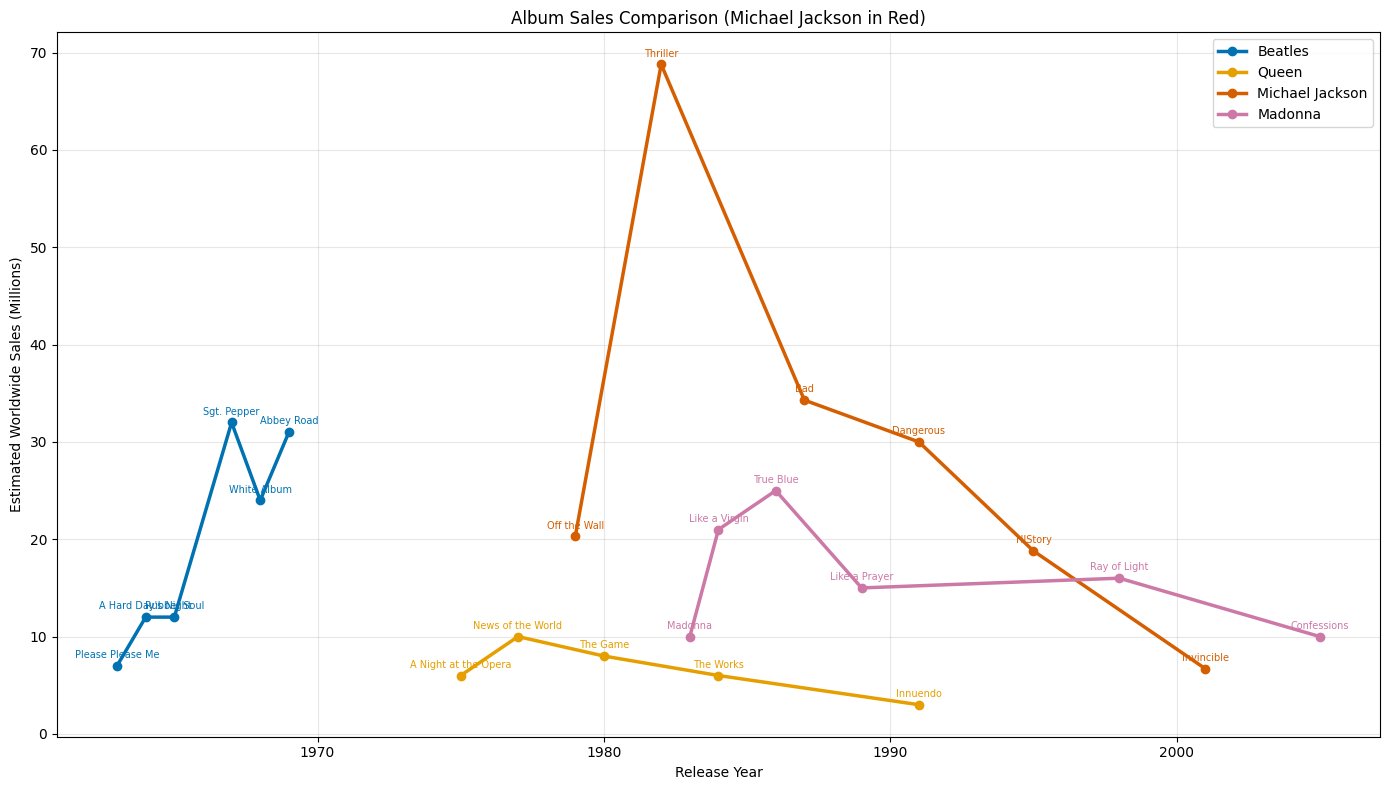
First of all, we can see that Thriller is a complete OVNI in terms of album sales, and that Michael never matched its success. An album like Bad, which sold half as many copies as Thriller, still surpasses any album from the Beatles, Madonna, or Queen. On such a scale, Invincible appears to be a very low-selling album; we can barely realize it was close in sales to Madonna's Confessions (the Hung Up album), and actually debuted at N°1 on the Billboard 200.
One needs to understand that such commercial "disappointment" was more than a hit on Michael's ego. Michael was in colossal debt and in need of money.
Michael's Finances
When I dug into Michael's finances, it was to understand how to make sense of what appeared to be a paradox:
- Michael was knee-deep in debt in the 2000s.
- Ten years after his death, the Michael Jackson Estate was debt-free and worth billions.
How the hell can you be richer while dead?
The answer is that Michael was asset-rich but cash-poor. More precisely, estimates put his net worth in 2005 at about $310 million, made of about $650 million in assets minus $340 million in debt.
The problem was that Michael was spending cash faster than the assets were generating new cash. In 1999, Michael's reported income, from assets, was $11.5M / year. How do you spend more than $11.5M per year?
Well, for starters, Neverland was basically an amusement park with no customers. It cost an estimated $5 million per year, or 43% of Michael's income.
Secondly, Michael was crazy with shopping. He could allow a lucky shopkeeper to retire with one shopping spree. In the documentary Living with Michael, he enters a shop in Las Vegas and does an inventory of what he has bought there, which includes several items worth hundreds of thousands of dollars.
At the end of the 2000s, Michael's solution for settling his debts was to perform the This Is It tour, which was meant to be his final tour. Unfortunately he died before doing the tour.
After his death, the cash burn stopped, and the Michael Jackson Estate multiplied its sources of revenue, releasing posthumous albums from unreleased songs, releasing the This Is It documentary (about the rehearsals for the tour), and selling parts of the assets. It took about three and a half years to settle the debts.
People v. Jackson
In addition to debt, the 2000s were marked by Michael's trial, as he was charged with sexually abusing Gavin Arvizo, a 13-year-old boy, giving him alcohol in order to do so, and conspiring to falsely imprison the family, abduct the children, and commit extortion. Michael was ultimately found not guilty of all charges.
Since the trial transcripts are public, I started reading them so that I could form my own opinion as if I were a juror. But this proved to be way too laborious, and I stopped after 4 days of trial (which is already pages and pages of transcripts). Those 4 days' worth of trial were already quite interesting.
The way it works is that at the beginning of the trial, each lawyer (the one prosecuting Michael and the one defending Michael) gets to tell their complete version of the story to the jury. In this telling, they get quite a lot of freedom to tell their story, which I personally found completely wild, even though their opening statement is not evidence and is supposed to outline what they expect the evidence to show. The point is that the rest of the trial will be dedicated to bringing evidence to support (or not) their story.
So you have the prosecution's opening statement telling about Michael and Frank Tyson showing porn on a laptop to Gavin Arvizo and his brother Star, in Michael's room on the last night of their first visit to Neverland, while Michael's own son (Prince) is sleeping in the room, and Michael telling him, "Prince, you're missing a lot of pussy." The prosecution claims this escalates, more than two years later, to Michael masturbating Gavin. In the meantime, Michael encourages the family to call him "Daddy Michael". Then several of Michael's employees basically isolate and pressure the family, including withholding the children until the family films a video praising Michael, and telling them that they can leave the ranch if they do a good job in the video and with the social workers. And many other things...
Then, you have the defense's opening statement telling about the Arvizo family being serial con artists trying to get money from celebrities, with Michael being just the latest and biggest mark of the series. The Arvizo mother had admitted to lying under oath in a previous lawsuit about whether her husband abused her, and the defense alleges that she coached her children in that lawsuit too. In the meantime, the Arvizo mother makes her family call Michael "Daddy Michael", which gives Michael a very bad feeling. And many other things...
Then, for days on end, witnesses are called to testify. Each witness is called by one side of the trial, starting with witnesses called by the prosecution. Each witness is generally first interrogated by the lawyer who called them before being "cross-examined" by the opposing lawyer.
At the end, the jury decides, from all the evidence, whether the prosecution proved each charge or not. Because of the principle of presumption of innocence, in order to conclude "not guilty", the jury does not need to be 100% confident about the defense's story fully holding up; they just need to have a reasonable doubt about whether the prosecution proved the charge. This is pretty much what happened in this case: According to comments made by jurors after the trial, credibility problems with Gavin and especially his mother contributed to the prosecution not crossing the threshold of proof beyond a reasonable doubt.
Michael's Death
I was shocked to discover how bad Michael's insomnia had become in the last months of his life. He had built such a tolerance to any sleeping pill that was asking for propofol, a general anesthetic. This was not a sleeping pill, but straight up an anesthetic normally used for medical procedures, which he was being given in his own bedroom.
At the same time, Michael was under a lot of stress from the rehearsals for the This Is It tour. As explained in the finances section, the tour was his ticket for getting out of debt, so there was a lot resting on the success of those concerts.
The circumstances of his death make the whole thing even worse. Conrad Murray, the doctor giving him propofol, was merely a cardiologist, not a licensed anesthesiologist. After finding Michael unresponsive, Murray did not call 911 immediately, and precious time was lost before a security guard finally made the call...
Michael's death was ruled a homicide. Murray was charged with involuntary manslaughter in 2011.
Conclusion
What made me very sad when finishing reading Michael's autobiography, Moonwalk released when he was only 29, is that he explains that he does not have memories in which he was not working. He started working at such a young age that at just 29, he already had a 25-years career, hence writing an auto-biography so "early".
The second sad thing is that he explains that he would like to get married and have a lot of children and raise them. We now know he had two failed marriages, and died when his oldest child was 12.
His words in Moonwalk, in hindsight, reads like a terrible tragedy. This of a man who didn't have a childhood, and didn't quite have the adulthood he was dreaming about either.
To find traces of joy in this difficult life, one needs to dig into his ethics of work, and the satisfaction he took out of surpassing himself creatively, in the studio and in live performances.
This resonates much with what Michael said in a 2007 interview with the magazine Ebony, which I'll conclude with:
Like Michelangelo, he said, “I know the creator will go, but his work survives. That is why to escape death, I attempt to bind my soul to my work.”